 Case study
A family planner in Telegram, built end to end by one person
Product, code, payments, analytics and a content engine — shipped solo and live in production. What I decided, what I built, and how I measure whether it works.
The problem
Household planning is invisible work, and it usually lands on one person.
Existing family apps ask for setup before they give anything back: create an account, connect a calendar, invite people, build lists. The person who carries the mental load does not want another system to maintain.
Broodli starts from the opposite end. A parent opens Telegram, answers three questions, and gets a plan for today. Lists, routines, reminders and family sharing grow from use, not from a setup wizard.
What it does
Three questions, then a plan
No calendar or email connection. The first useful output arrives in under a minute, which is the whole retention bet.
Text and voice in, a day out
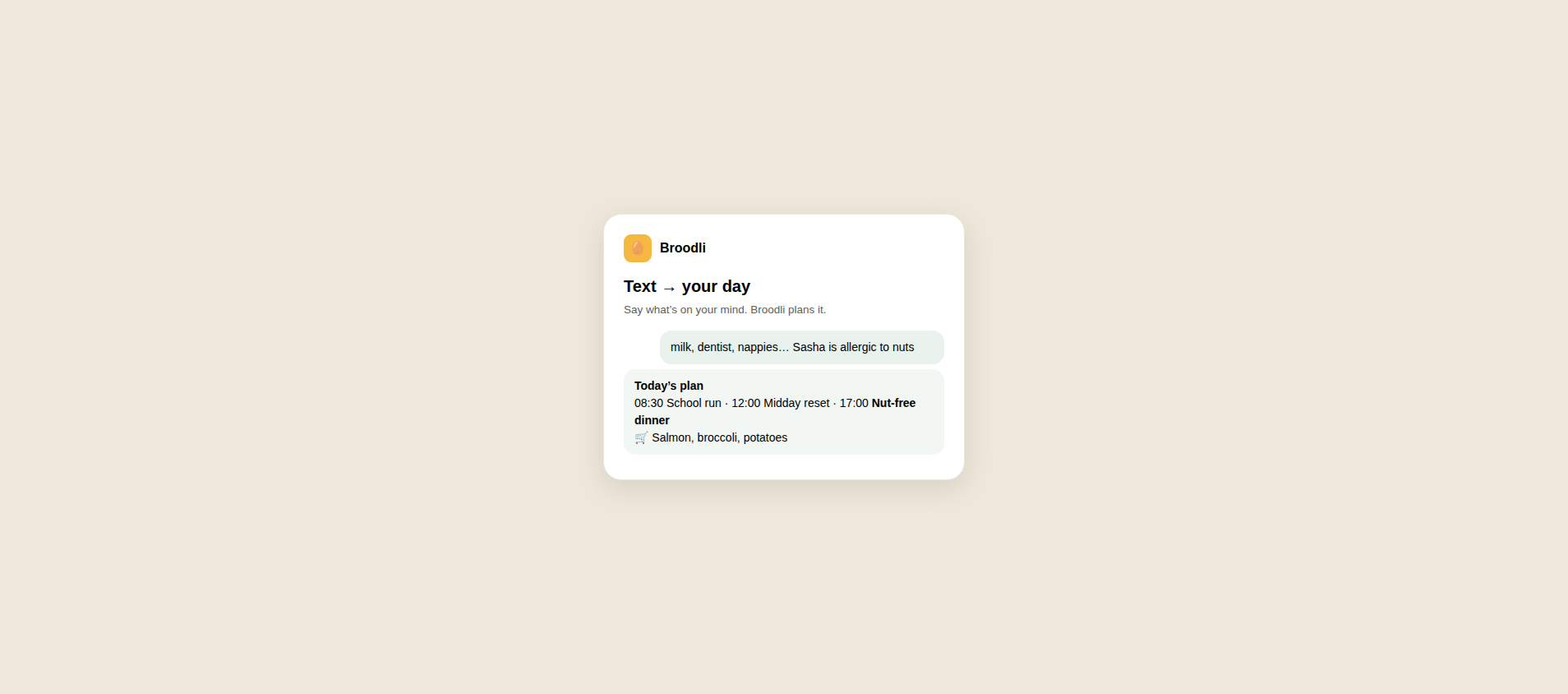
“Milk, dentist, nappies, Sasha is allergic to nuts” becomes a plan with times, a shopping list and a dinner that fits.
Shared lists and assignments
Up to six members, shared open lists, task assignment with a direct Telegram notification, weekly repeats.
A lighter day, on request
“Too much” and “just right” feedback changes the pace of the current and future plans instead of only apologising.
Invites that reward both sides
A personal invite link: the invitee gets seven extra trial days, the referrer gets seven once the invitee finishes onboarding. Self-invites are ignored.
Decisions I made
Four calls that shaped the product more than any feature.
Telegram instead of an app
No install, no push infrastructure, no app-store review. The cost is platform risk and a smaller market — acceptable for a first version.
AI with a deterministic fallback
If the model is down or returns something unparseable, the user still gets a plan from a template. A planner that fails to plan is not a planner.
Price on AI actions, not seats
The free tier is deliberately tight, and the paid tiers are sized by daily AI actions — the actual cost driver — rather than by team size.
Activation before acquisition
Onboarding, the first plan and the pacing feedback came before any paid channel. Paying for traffic before activation works is how products die politely.
How it is built
Two services, six packages, one repository, one deploy pipeline.
apps/bot— grammY bot: onboarding, plans, lists, routines, reminders, family assignment, paid tiers, promo codes, admin stats.apps/worker— scheduled recurring tasks and reminder delivery.packages/core— plan prompts, strict response parsing, deterministic template fallback.packages/planner,db,quotas,llm,shared— domain logic, Postgres schema and migrations, quotas, model clients.- Docker Compose on a VPS behind Caddy; Postgres and Redis;
/healthfor production checks. - GitLab CI runs typecheck, build and the full test suite on every push.
- Payment webhooks are HMAC-verified with constant-time comparison; admin commands are restricted to an allowlist of Telegram IDs.
AI in the loop
Three different jobs, three different bars.
In the product
Gemini generates plans and extracts tasks from text and voice. Responses are parsed strictly; when that fails, a deterministic template takes over. A rolling token budget warns admins before the bill surprises them.
In the build
I build with Claude Code and OpenCode against a written spec: positioning, feature status, decision gates. The docs are the contract the agents work from, which is why they live in the repo next to the code.
In growth — a closed loop
A scheduled agent writes and renders short episodes three times a week and posts to Instagram, Telegram, Facebook, YouTube and TikTok. It then pulls the metrics back, groups episodes by hook, and feeds a brief from the last measured ones into the next story. It refuses to call a winning hook before three measured episodes.
How I decide whether it lives
Metrics were instrumented before launch, and the kill criteria were written down before the first ad dollar.
Every funnel step is tracked: started → onboarding_completed → plan_created → day-2 return → purchase. Attribution travels in the Telegram start parameter, so a channel can be judged on users, not clicks.
| Step | Keep going | Stop / pivot |
|---|---|---|
| Landing → bot | ≥ 25% | < 15% |
| Onboarding completed | ≥ 50% | < 35% |
| Day-3 return | ≥ 30% | < 15% |
| Day-7 return | ≥ 20% | < 10% |
The gate was written before the first ad dollar. Deciding in advance what would make me stop is what separates a product bet from a hobby — and it is the first thing I set up.
Links
- @broodli_bot — the live product
- broodli.com — landing page
- Interactive demo — no signup
- 60-second demo video
Source is private. Architecture, decisions and this write-up are what I can share; a code walkthrough is available on request.